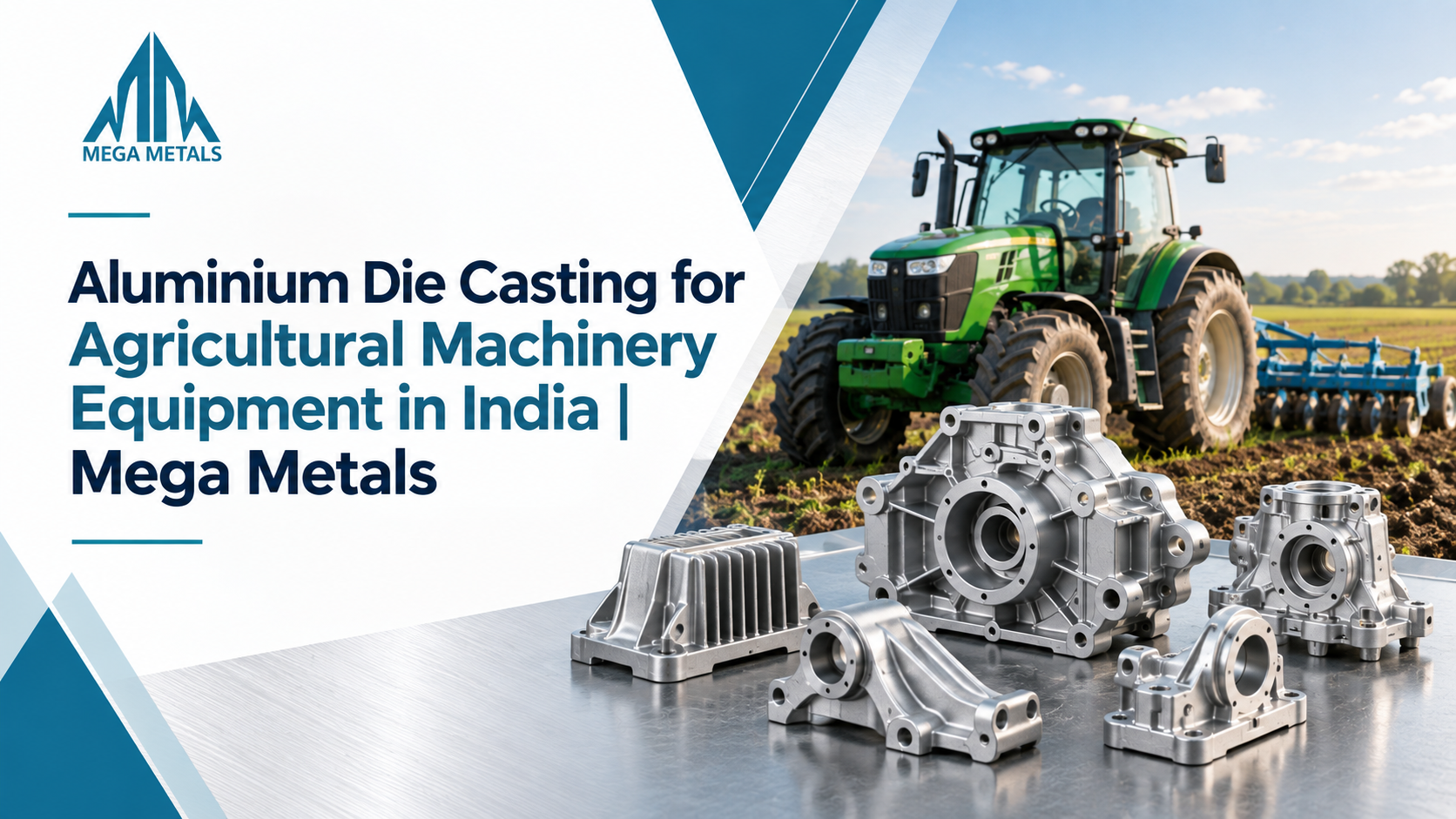
Modern agricultural machinery depends on precision-engineered components to support reliable operation, durability and efficient equipment design. As agricultural equipment continues to evolve, manufacturers increasingly require components that combine strength, dimensional accuracy, lightweight construction and consistent production quality.
Agricultural Machinery Aluminium Die Casting is one manufacturing approach used to produce aluminium components for agricultural equipment and machinery. High-pressure die casting can produce complex metal components with repeatable dimensions and suitable surface characteristics for high-volume applications.
For manufacturers searching for agricultural machinery equipment in India, selecting an experienced aluminium die casting and precision manufacturing partner can be an important part of the component sourcing process.
Mega Metals India provides aluminium die casting, machining, engineering and manufacturing solutions and lists agricultural machinery equipment among the industries it serves.
What Is Agricultural Machinery Aluminium Die Casting?
Agricultural Machinery Aluminium Die Casting involves using high-pressure die casting technology to manufacture aluminium components used in agricultural machinery and equipment.
In the high-pressure die casting process, molten aluminium alloy is injected into a specially engineered steel die under high pressure. The metal solidifies inside the die to form the required component geometry.
According to Mega Metals' knowledge centre, aluminium HPDC can produce components with complex geometries, thin walls, dimensional accuracy and repeatable production characteristics.
This makes aluminium die casting suitable for manufacturers looking for precision components for different machinery and equipment applications.
Why Is Aluminium Die Casting Used for Agricultural Machinery?
Agricultural equipment can operate in demanding environments and often requires components that balance mechanical performance, weight, durability and manufacturing efficiency.
Aluminium die casting can provide several manufacturing advantages.
Lightweight Construction
Aluminium is significantly lighter than steel, which can help manufacturers manage component weight where the application permits.
Lower component weight can be relevant when designing machinery where overall equipment weight is an important consideration.
Complex Component Geometry
High-pressure die casting can produce complex shapes and integrated features that may otherwise require multiple manufacturing operations.
Dimensional Consistency
A properly designed die casting process can provide repeatable component dimensions across production runs.
This is particularly important for OEMs and manufacturers requiring consistent component specifications.
High Production Efficiency
HPDC is suited to high-volume manufacturing because the process can have relatively short cycle times once the tooling and production process are established. Mega Metals' knowledge centre describes HPDC cycle times in the range of approximately 15–60 seconds depending on the application and process.
Surface Finish
Aluminium die casting can provide suitable surface quality for many industrial components, potentially reducing the amount of additional finishing required depending on the component specification.
What Agricultural Machinery Components Can Be Made Using Aluminium Die Casting?
The exact components suitable for aluminium die casting depend on the equipment design, loading conditions, material requirements and manufacturing specifications.
Potential applications can include:
- Housings
- Covers
- Brackets
- Mounting components
- Structural components
- Gearbox-related housings
- Motor-related housings
- Protective covers
- Agricultural equipment sub-components
- Custom-engineered aluminium components
The final component design should be evaluated according to its mechanical requirements, operating environment, dimensional tolerances and manufacturing process.
Agricultural Machinery Equipment in India: Why Component Quality Matters
India has a broad agricultural machinery ecosystem covering tractors, harvesting equipment, irrigation systems, seeders, tillers and other agricultural equipment.
For manufacturers of agricultural machinery equipment in India, component quality can influence production consistency and the performance of the final machine.
Important considerations include:
- Material specification
- Component dimensions
- Tolerances
- Mechanical requirements
- Surface finish
- Corrosion considerations
- Machining requirements
- Quality inspection
- Production consistency
A component supplier should therefore be evaluated based on its ability to meet the technical requirements of the application.
Aluminium Die Casting vs Other Manufacturing Methods
The appropriate manufacturing process depends on component geometry, production volume, material requirements and dimensional specifications.
| Factor | Aluminium HPDC | CNC Machining | Fabrication |
|---|---|---|---|
| Complex geometry | Suitable for many complex shapes | Highly flexible | Depends on design |
| Production volume | Suitable for medium/high volume | Suitable for varied volumes | Application dependent |
| Repeatability | High with controlled tooling/process | High | Depends on process |
| Tooling requirement | Die required | Tooling/programming required | Fixtures/tools may be required |
| Lightweight aluminium parts | Suitable | Suitable | Suitable |
| Additional machining | May be required | Primary process | May be required |
For high-volume aluminium components, die casting can be considered alongside other manufacturing processes based on the technical and commercial requirements of the project.
How Does Agricultural Machinery Aluminium Die Casting Work?
A typical aluminium HPDC production process involves several stages.
Step 1: Component Design
The component is designed according to its intended application, dimensions, tolerances and performance requirements.
Design-for-manufacturing considerations are important at this stage because component geometry can affect die design, filling, cooling and production performance.
Step 2: Die Development
A steel die is developed according to the required component geometry.
The die determines the shape and important features of the final casting.
Step 3: Aluminium Melting
The selected aluminium alloy is melted according to the required material specification.
Mega Metals states that its melting and alloying operations support multiple aluminium grades, including ADC12, A380, AlSi12Fe, AlSi10Mg and LM6.
Step 4: High-Pressure Injection
Molten aluminium is injected into the die cavity under high pressure.
Step 5: Solidification
The aluminium solidifies within the die while pressure and cooling conditions help form the required component.
Step 6: Ejection & Trimming
After solidification, the casting is removed from the die and excess material is trimmed.
Step 7: Machining
Where required, additional CNC machining can be performed to achieve specific dimensional or functional requirements.
Mega Metals lists CNC turning, vertical machining, drill-tap centres and 4th-axis capabilities as part of its machining operations.
Step 8: Inspection
The finished component is inspected against the required specifications.
Depending on the component and quality requirements, inspection can include dimensional measurement, material analysis and non-destructive testing.
What Should Agricultural Equipment Manufacturers Consider?
If you are sourcing aluminium components for agricultural machinery equipment in India, consider the following factors before selecting a manufacturing partner.
1. Aluminium Alloy
The alloy should be selected according to the component's mechanical, thermal, corrosion and manufacturing requirements.
2. Component Design
The design should be evaluated for manufacturability before tooling begins.
3. Production Volume
Production volume can influence whether HPDC is commercially appropriate and how tooling costs are distributed across the production run.
4. Dimensional Requirements
Define important dimensions, tolerances and machining requirements before production begins.
5. Machining Requirements
Some die-cast components require additional machining for holes, mounting surfaces, threads or precision interfaces.
6. Quality Control
Quality inspection should be integrated into the manufacturing process rather than treated only as a final-stage activity.
7. Tooling & Die Management
Tool design, maintenance and lifecycle management can have a direct effect on production consistency.
Why Choose an Integrated Aluminium Die Casting Manufacturer?
Agricultural machinery manufacturers may need more than basic casting.
A supplier that can combine several manufacturing capabilities can potentially simplify the component development and production process.
An integrated solution can include:
- Product design support
- CAD modelling
- Simulation
- Die development
- Aluminium melting
- High-pressure die casting
- Trimming
- CNC machining
- Quality inspection
- Assembly
- Production support
Mega Metals states that its engineering capabilities include CAD, simulation and 3D CAM, while its manufacturing operations combine HPDC with machining and quality-control capabilities.
Why Consider Mega Metals for Agricultural Machinery Components?
Mega Metals India serves multiple industrial sectors, including agricultural machinery equipment, automotive, electric motors, power tools, construction equipment, furniture, home appliances and electric vehicles.
Its manufacturing capabilities include:
- Aluminium high-pressure die casting
- Precision CNC machining
- Engineering and design support
- Tool and die management
- Prototyping
- Quality inspection
- Custom component manufacturing
The company states that its HPDC capability extends to approximately 900T and that it provides end-to-end aluminium die casting and sub-assembly solutions for domestic and export markets.
For agricultural machinery manufacturers, the ability to combine casting, machining and engineering support can be useful when developing and manufacturing custom aluminium components.
Quality Control in Aluminium Die Casting
Quality control is an important consideration when sourcing components for agricultural equipment.
Depending on the application, manufacturers may evaluate:
- Dimensional accuracy
- Material composition
- Mechanical properties
- Surface finish
- Internal defects
- Porosity
- Leakage
- Machined dimensions
- Component consistency
Mega Metals lists inspection technologies including 3D CNC CMM, X-ray, spectrometer, profile projector, contour tracer, microscope, roughness tester, leak testing equipment, tensile testing and hardness testing among its quality-control capabilities.
The exact inspection plan should be established according to the component's engineering requirements.
Benefits of Working With a Precision Aluminium Component Manufacturer
For agricultural machinery manufacturers, working with a specialised component manufacturer can offer advantages throughout the product-development and production process.
Engineering Support
Design and engineering input can help identify manufacturing considerations before tooling.
Custom Manufacturing
Components can be developed around application-specific dimensions and requirements.
Machining Integration
Combining casting with CNC machining can reduce the need to coordinate separate suppliers for different production stages.
Production Scalability
A suitable HPDC setup can support repeatable production for components requiring larger production volumes.
Quality Processes
Structured inspection and testing can help verify components against defined specifications.
Conclusion
The growing requirements of modern agricultural equipment make precision component manufacturing an important part of machinery development.
Agricultural Machinery Aluminium Die Casting can provide manufacturers with a method for producing lightweight, complex and repeatable aluminium components, particularly where production volumes and component geometry make HPDC appropriate.
For businesses manufacturing agricultural machinery equipment in India, selecting the right component manufacturing partner involves evaluating engineering capabilities, die casting technology, tooling, machining, quality control and production support.
Mega Metals India combines aluminium HPDC, engineering, tooling, machining and quality-control capabilities to support custom aluminium component manufacturing across multiple industries, including agricultural machinery equipment.
For agricultural machinery manufacturers looking for precision aluminium components, the next step is to evaluate the component drawing, alloy requirement, production volume, tolerance and machining requirements before finalising the manufacturing process.

